Showing posts with label Measurement. Show all posts

Monday, 8 August 2016

Specifically, what is complexity?

People involved in software projects would say that software development is about understanding complexity.

What is complexity?

What can we do about it?

Complexity is easy to define at a high level, but people get vague when pressed for a precise definition.  Let's see if we can:

  • quantify the problem
  • define it
  • suggest how to address it

2 Brooks, Frederick Phillips. “The Mythic Man Month”, 1995. ISBN 0-201-00650-2

Friday, 22 August 2014

Infeasible Projects: Executive Ignorance or IT Impotence?

DohDoh2Infeasible software projects are launched all the time and teams are continually caught up in them, but what is the real source of the problem?

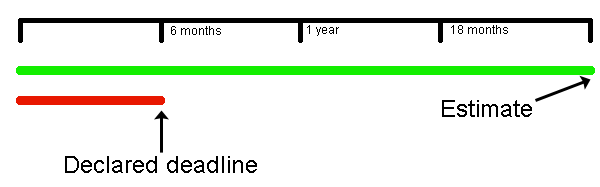
There are 2 year actual projects for which the executives set a 6 month deadline.

The project is guaranteed to fail but is this due to executive ignorance or IT impotence? InfeasibleTimeline

There is no schedule risk in an infeasible project because the deadline will be missed.  Schedule risk only exists in the presence of uncertainty (see Schedule Risk is a Red Herring!!!)

As you might expect, all executives and IT manager share responsibility for infeasible projects that turn into death marches.  Learn about the nasty side effects Death March Calculus. The primary causes for infeasible projects are:
  • Rejection of formal estimates
  • No estimation or improper estimation methods are used

Rejecting Formal Estimates

This situation occurs frequently; an example would be the Denver Baggage Handling System (see Case Study).

The project was automatically estimated (correctly) to take 2 years; however, executives declared that IT would only have 1 year to deliver.

Of course, they failed1.

The deadline was rejected by executives because it did not fit their desires.  They could not have enjoyed the subsequent software disaster and bad press.

When executives ignore formal estimates they get what they deserve.  Formal estimates are ignored because executives believe through sheer force of will that they can set deadlines.

If IT managed to get the organization to pay for formal tools for estimating then it is not their problem that the executives refuse to go along with it.


Improper Estimation Methods

The next situation that occurs frequently is using estimation processes that have low validity.  Estimation has been extensively studied and documented by Tom DeMarco, Capers Jones, Ed Yourdon, and others.

Improper estimation methods will underestimate a software project every time. Fast estimates will be based on what you can think of, unfortunately, software is not tangible and so what you are aware of is like the tip of an iceberg.

None of this prevents executives demanding fast estimates from development.  Even worse, development managers will cave in to ridiculous demands and actually give fast estimates.

Poor estimates are guaranteed to lead to infeasible projects (see Who needs Formal Measurement?) Poor estimates are delivered by IT managers that:
  • Can't convince executives to use formal tools
  • Give in to extreme pressure for fast estimates
Infeasible projects that result from poor estimates are a matter of IT impotence.

Conclusion

Both executive ignorance and IT impotence lead to infeasible projects on a regular basis because of poor estimates and rejecting estimates; so there is no surprise here.

However, infeasible projects are a failure of executives and IT equally because we are all on the same team. It is not possible for part of the organization to succeed if the other one fails.

Possibly a greater share of problem is with IT management.  After all, whose responsibility is a bad decision -- the guys that know what the issues are or the ones that don't.

If a child wants ice cream before they eat dinner then whose fault is it if you cave in and give them the ice cream?

Unfortunately, even after 60 years of developing software projects, IT managers are either as ignorant as the executives or simply have no intestinal fortitude.

Even when IT managers convince executives of the importance of estimating tools, the estimates are routinely discarded because they do not meet executive expectations.

Rejection of automated estimates: productivity -16%, quality -22%

Until we can get a generation of IT managers that are prepared to educate executives on the necessity of proper estimation and be stubborn about holding to those estimates, we are likely to continue to have an estimated $3 trillion in failures of software projects every year.


End Notes

1For inquiring minds, good automated estimation systems have been shown to be within 5% of time and cost on a regular basis. Contact me for additional information.

References

Tuesday, 8 July 2014

Seriously. The Devil Made me do It!

Just as eternal as the cosmic struggle between good and evil is the challenge between our two natures. Religion aside, we have two natures, the part of us that:
  • thinks things through; makes good or ethical decisions a.k.a. our angelic nature
  • reacts immediately; makes quick but often wrong decisions a.k.a. our devil nature
Guess the powers that be left a bug in our brains so that it emphasizes fast decisions over good / ethical decisions.

Quite often we make sub-optimal or ethically ambiguous decisions under pressure

You decide...

Situation: Your manager comes to you and says that something urgent needs to be fixed right away. Turns out the steaming pile of @#$%$ that you inherited from Bob is malfunctioning again. 

Of course Bob created the mess and then conveniently left the company; in fact, the code is so bad that the work-arounds have work-arounds.

Bite the bullet, start re-factoring the program when things goes wrong.  It will take more time up front, but over time the program will become stable.  Start code inspections on the critical sections to proactively reduce defects (see Inspections are not Optional)

Find another fast workaround and defer the problem to the future.  Find a good reason why the junior member of the team should inherit this problem.

Situation: You've got a challenging section of code to write and not much time to write it.

Get away from the computer, think things through.  Get input from your peers, maybe they have seen this problem before. 

Then plan the pathways out and write the code once cleanly. Taking time to plan seems counter intuitive, but it will save time. (see Not Planning is for Losers)

Naw, just sit at the keyboard and bang it out already.  How difficult can it be?

Situation: The project is late and you know that your piece is behind schedule. However, you also know that several other pieces are late as well.

Admit that you are late and that the project can't finish by the deadline.  Give the project manager and senior managers a chance to make a course correction.

Say that you are on schedule but you are not sure that other people (be vague here) will have their pieces ready on time and it could cause you to become late.

This situation is also known as Schedule Chicken...

Situation: You have been asked to estimate how long a critical project will take. You are only been given a short time to come up with the estimate.

Tell the project manager that getting a proper estimate takes longer than a few hours. Without proper estimates the project is likely to be severely underestimated and this will come back to bite you and the project manager in the @$$.  (See Who needs Formal Measurement?)

Tell the project manager exactly the date that senior management wants the project to be finished by.  You know this is what they want to hear, why deal with the problem now? This will become the project manager's problem when the project is late.

The statistics show that we often don't listen to our better (angelic?) natures very often.

So when push comes to shove and you have to make a sub-optimal or less than ethical decision, just remember:
The devil made you do it!
Run into other common situations? email me

Friday, 27 June 2014

Failed? You get what you deserve!

Consider this, few projects fail because of unusual or unforeseen problems.  If you are trying to go so fast that you don't do your due diligence or decide to skip steps then -- "You get what you deserve!".

Projects succeed because they do not rely on force of personality and luck.

Only 3 of 10 software projects succeed (see Understanding Your Chances). Success happens when you implement best practices and avoid worst practices; not just talk about them and convince yourself that you are doing them.

Therefore 7 out of 10 projects fail, even if you redefine 'challenged projects' as political victories; these projects are often severely over time and budget.

It is estimated that between $3 trillion and $6 trillion dollars are wasted every year in IT; by organizations that "don't know, and don't know that they don't know", i.e. what you don't know can definitely hurt you.

What is amazing is that failures do not prompt the incompetent to learn why they failed.  After the post-fail finger-pointing ceremony, people just dust themselves off and rinse and repeat.

There is never enough time to do the project correctly, but there is always enough time to do it again.


Ingredients of a Successful Project


Successful software projects have the following characteristics:
  • Effective capital budgeting
  • Proper project sizing
  • Estimate uncertainty
  • A focus on defect removal

Capital Budgeting

Capital budgeting means having business cases for major projects and allocating capital to the most promising projects; a little due diligence prevents bad projects from starting.

For example, RJ Reynolds invested $325 million to develop smokeless cigarettes when they knew in the initial pilot that the cigarette tasted bad and no one would buy them.

Project Sizing

If a project has a good business case, then the next step is to figure out how big the project is.  This requires that you expand  the requirements sufficiently to estimate time and cost.

When it comes to software -- size matters.

Not only does size matter, you need to understand the level of uncertainty (requirements, technical, or skill) tied to your project to understand how much re-work or discovery will be necessary.

  • Re-engineering a product with new technologies?  (high technical uncertainty)
  • Building a new product with existing technologies? (high requirements uncertainty)
  • Building software with a team unfamiliar with the technology? (have high skills uncertainty)

Skipping the time to get estimates is a major cause of project failure

There are still executives that give engineering a few hours or a few days to estimate major projects and wonder why the projects go late or get cancelled.

Estimate Uncertainty

Project methodology needs to take into account expected uncertainty.

Projects with low uncertainty can be handled with a traditional project methodology; these projects can have their work breakdown structures elaborated and dependencies can be worked out ahead of time.

Projects with moderate to high uncertainty will require rework and discovery.  This must be built into the project plan or you need to switch to an Agile methodology.  If you don't then there will be missing tasks on the project plan as well as task duration that is under-estimated.

Project tasks get stuck at 90% complete because the sources of uncertainty are not established a priori

Executing a project with personnel that are not competent with the technologies that you want to use is essentially professional malpractice.  If you must use existing personnel that don't know the technologies you want then you need to build in a large margin for training and rework over the project; these projects will take at least 2x as long as your worst estimate.

Focus on Early Defect Removal

Developer's say: "There is never enough time to write the code".  Statistics say, "There is never enough time to find all the defects" (see The Programmer Productivity Paradox).  To be successful you need to find defects as quickly as possible, especially since:

  • If it costs X to find a defect pre-test 
  • It costs 10X to find it in QA
  • It costs 100X to find it once deployed in the field

You do the math, it costs less to find defects before they get to QA.  You are kidding yourself if you think that it is cost effective to have huge QA departments (see The Cost of Not Doing Quality).

Conclusion


Building software reliably and repeatably is not difficult.  What is difficult is getting organizations to realize that there is a minimum set of processes that must be followed to have a successful project.

Organizations regularly skip one or more steps and wonder projects fail to come together and succeed.

Monday, 3 June 2013

To be, or not to be... Formal

What the heck is a formal process?  Is it in the category of you know it when you see it?

A formal process is a methodical way of tackling any repetitive process so that it can be handled in a standardized way.  The idea of formality is to reduce variation in output and minimize the chance of forgetting something.  Formal processes include the ideas of studying, planning, measurement, and process refinement; they cost more and take longer than just just jumping in and getting things done.

Imagine if they tried to make cars in an informal way

Informal, or not formal processes, are faster and cheaper because you get rid of the overhead of a formal process.  It makes sense to be informal when the variation of the process output is not very sensitive to studying, planning, measurement, or refinement.

We are all familiar with trying to use formality when it makes no sense, you simply end up with process for processes sake and waste time and money.

In software, formality has become synonymous with documentation, and frankly we all hate documentation. We don't like to produce it and we don't like to read it.  I've instructed hundreds of engineers and only a few people bother to read the requirements brick.  The way education is going right now I'm not even sure that university graduates can read anyways, but I digress... :-)

For example, documentation for requirements, design, and testing is the end result of a formal process, it is not the formal process itself.  It is smart not to produce more documentation than you need, but that does not mean that the formal processes that creates the documentation are optional.

Formal processes in software development cluster around two very simple ideas:
  • getting the correct requirements
  • elimination of defects
The problem is that formal processes only work when you do enough of them to make a difference.  That is not doing enough of a formal process is just as bad as doing too much.  For example, UML class diagrams will not only help you to plan code but also educate new developers on the team.

Producing UML diagrams is a formal practice; however, if you insist on producing UML diagrams for everything then you will end up spending a significant amount of time creating the diagrams to get a diminishing benefit.  Not having any UML diagrams will lead to code being developed more than once simply because no one has a good overview of the system.
Selective UML diagrams can really accelerated your development

Visualizing Formality

As you increase any formal practice the effect of that practice will increase, for example the more formal you are with UML diagrams the less defects you are likely to have:

However, as you increase formality, the costs of keeping track of all your artifacts goes up:
When you put the two graphs together you get this effect:
This shows that there is a cost to not having enough formality, i.e. no UML diagrams means that more code will get developed and less reuse means more defects.  However, producing too many UML diagrams will also have the cost of producing the UML diagrams and keeping them updated.  The reality is that for any formal practice there is a sweet spot where the minimal formality gives the lowest cost.

What that means is that productivity will be maximized in the sweet spot.

Remember that most formal practices are hygiene practices, these are things that no one wants to do but are really necessary to be highly productive and produce high quality code (see here for more on hygiene practices)

Statistics Behind Formal / Informal Practices

Formal practices can be applied to many things, but Capers Jones has measured the following formal practices (when properly executed) can have a positive effect on a project (15,000+ projects): 

Formal risk management can raise productivity by 17.8% and quality by 26.4%
Formal measurement programs can raise productivity by 20.0% and quality by 30.0%
Formal test plans can raise productivity by 16.6% and quality by 24.1%
Formal requirements analysis can raise productivity by 16.3% and quality by 23.2%
Formal SQA teams can raise productivity by 15.2% and quality by 20.5%
Formal scope management can raise productivity by 13.5% and quality by 18.5%
Formal project office can raise productivity by 11.8% and quality by 16.8%

A special category of formal practices are inspections:
Formal code inspections can raise productivity by 20.8% and quality by 30.9%
Formal requirements inspections can raise productivity by 18.2% and quality by 27.0% Formal design inspections can raise productivity by 16.9% and quality by 24.7%
Formal inspection of test materials can raise productivity by 15.1% and quality by 20.2%

More information on inspections can be found here:
Not being formal enough has its costs, and it is rarely neutral.  Here are some of the costs of not being formal enough:
Informal progress tracking can lower productivity by 0.5% and quality by 1.0%
Informal requirements gathering can lower  productivity by 5.7% and quality by 8.4%
Inadequate risk analysis can lower  productivity by 12.5% and quality by 17.5%
Inadequate testing can lower  productivity by 13.1% and quality by 18.1%
Inadequate measurement of quality can lower  productivity by 13.5% and quality by 18.5%
Inadequate defect tracking can lower  productivity by 15.3% and quality by 20.9%
Inadequate inspections can lower  productivity by 16.0% and quality by 22.1%
Inadequate progress tracking can lower  productivity by 16.0% and quality by 22.5%

N.B. progress tracking is on the list twice.  Informal progress tracking is fairly neutral, but inadequate progress tracking is deadly.

Conclusion

In development practices it is not a matter of formal vs informal.  It is a matter of seeing what kind of variation that you are exposed to and recognizing that formality can make a difference in that area.  Then it is a matter of only adding as much formality as you need to get maximum productivity.

Formal practices must be monitored, you must have some way of testing if the formal practice is having an effect on your development.  You want to make sure that you are executing all formal practices properly and not just going through the motions of a formal practice with no effect.  You must monitor the effects of formality to understand when you are not doing enough and when you are doing too much!


Articles in the "Loser" series
Moo?

Want to see sacred cows get tipped? Check out:
Make no mistake, I am the biggest "Loser" of them all.  I believe that I have made every mistake in the book at least once :-)

Thursday, 30 May 2013

Who needs Formal Measurement?


We all know the expression "You can't manage what you can't measure", but do we really understand it?

After execution, feedback is an essential part of all processes.  Just think about how difficult it would be to drive from home to work wearing a blindfold.  Without your sense of sight to give you feedback on the traffic signals and the locations of other cars you would crash your car.  Yet we develop software systems without instituting formal measurement programs all the time and wonder why we succeed so rarely?  (for success rates see Understanding your chances of having a successful software project)

You can't manage what you can't measure

No measurement means no feedback, which means your chances of success are minimized. Success is possible without formal measurement but it is much easier with formal measurement.

Formal measurement raises productivity by 20.0% and quality by 30.0%

A best practice is one that increases your chance of succeeding, it does not guarantee it. It has been established that formal measurement is a best practice, so why do so few people do it?

Measurement has a cost and organizations are petrified of incurring costs without incurring benefits. After all what if you institute a measurement program and things don't improve?  In some sense managers are correct that measurement programs cost money to develop and unless measurement is executed correctly it will not yield any results.

But is there a downside to avoiding measurement?

Inadequate progress tracking reduces productivity by 16.0% and quality by 22.5%

Failure to estimate requirements changes reduces productivity by 14.6% and quality by 19.6%

Inadequate measurement of quality reduces productivity by 13.5% and quality by 18.5%

So there are costs to not having measurement.  Measurement is not optional, measurement is a hygiene process, that is, essential to any process but especially to software development where the main product is intangible.

A hygiene process is one which can prevent very bad things from happening. Hygiene processes are rarely fun and take time, i.e. taking a shower, brushing your teeth, etc.

History has show that it is much more cost effective to execute a hygiene process than take a chance of something very bad from happening, i.e. disease or your teeth falling out.

There are hygiene practices that we use every day in software development without even thinking about it:
  • Version control
  • Defect tracking
Version control is not fun, tracking defects is not fun, but the alternative is terrible.  Only the most broken organizations think that they can develop software systems without these tools.  These tools are not fun to use and virtually everyone complains about them, but the alternative is complete chaos.

Formal measurement is a best practice and a hygiene practice

The same way that developers understand that version control and defect tracking is necessary, an organization needs to learn that  measurement is necessary.

Is Formality Necessary?
The reality is that informal measurement is not comprehensive enough to give consistent results. If measurement is informal then when crunch time comes then people will stop measuring things when you need the data the most.

When you don't have enough formality then processes take longer and by extension cost more.  When you have too much formality then you have process for processes sake and things will also take a long time.  Any organization that implements too much formality is wasting their time, but so is any organization that does not implement enough.

When you suggest any formal process people immediately imagine the most extreme form of that process; which would be ridiculous if it is implemented that way. We have all been in organizations that implement processes that make no sense, but without measurement how do you get rid of these processes that make no sense?

For every formal process that makes sense, there is a spectrum of implementations.  The goal is to find the minimum formality that reduces time and costs.  When you find the minimum amount of formal measurement you will accelerate your development by giving yourself the feedback that you need to drive your development.


What to Measure
It seems obvious, but incorrect measurement and/or poor execution leads to useless results.  For example, trying to measure productivity by measuring the hours that the developers sit at their machines is as useful as measuring productivity by the number of cups of coffee that the developers drink.

Another useless measure is lines of code (LOC), in fact, Capers Jones believes that anyone using LOC as a measurement should be tried for professional malpractice!

Measuring the the three things mentioned above will improve productivity and quality because there will not be a negative effect on your organization:
  • measuring progress tracking (productivity +16.0%, quality +22.5%)
  • estimating requirements changes  (productivity +14.6%, quality +19.6%)
  • measurement of quality (productivity +13.5%, quality +18.5%)
Other things to measure are:
  • Activity based productivity measures (productivity + 18.0% , quality by 6.7%
  • Automated sizing tools (function points)  (productivity + 16.5% , quality by 23.7%
  • Measuring requirement changes  (productivity + 15.7% , quality by 21.9%

So to answer the question: who needs formal measurement?
We all need enough formal measurement to get the job done


References
N.B. All productivity and quality percentages were derived over 15,000+ actual projects

Articles in the "Loser" series

Moo?

Want to see sacred cows get tipped? Check out:
Make no mistake, I am the biggest "Loser" of them all.  I believe that I have made every mistake in the book at least once :-)